
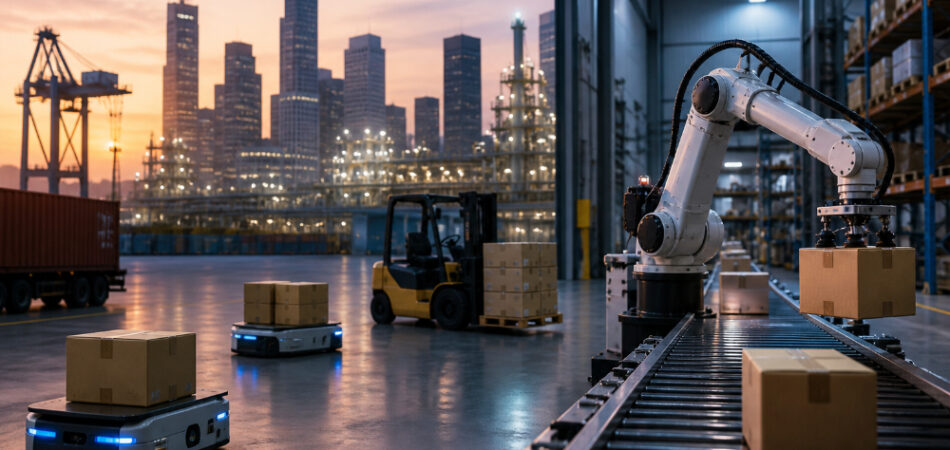
Houston, TX has long been recognized as one of the most dynamic industrial hubs in the United States. From its sprawling petrochemical corridors to its vast logistics networks, the city’s supply chain infrastructure is the backbone of countless industries. As global demand grows and operational complexity increases, industrial automation is no longer a luxury for businesses operating in this region. It has become an absolute necessity. Companies that fail to adopt modern automation systems risk falling behind in an environment where speed, accuracy, and efficiency determine who survives and who does not.
The pressure to modernize is real. Labor shortages, rising operational costs, and increasingly complex customer expectations are pushing Houston-based businesses to rethink how they manage their supply chains from end to end. Industrial automation offers a proven path forward, and the businesses that embrace it today are the ones that will define the industry tomorrow.
The Scale of Houston’s Industrial Landscape Demands Smarter Solutions
Houston is not your average city when it comes to industrial output. It is home to the largest petrochemical complex in the Western Hemisphere, a massive port system that ranks among the busiest in the nation, and a manufacturing sector that spans aerospace, energy, food processing, and heavy equipment. Managing supply chains at this scale without automation is like trying to navigate a major highway without instruments. The margin for error is simply too small.
Supply chain efficiency in a city of this magnitude requires systems that can process enormous volumes of data, coordinate across multiple facilities, and respond to disruptions in real time. Manual processes, no matter how well-managed, introduce delays, inconsistencies, and errors that compound over time. Industrial automation closes those gaps by creating consistent, repeatable workflows that operate at a speed no human team can match independently.
Warehouse control systems play a critical role here. These platforms integrate hardware and software to manage the flow of goods through storage and distribution facilities, tracking inventory in real time and directing workers or automated equipment to the right locations at the right times. For Houston businesses managing large-scale distribution operations, warehouse control systems are the central nervous system of supply chain performance.
Industrial Automation Directly Improves Supply Chain Efficiency
One of the most compelling arguments for industrial automation in Houston is its direct and measurable impact on supply chain efficiency. When automation systems are properly implemented, businesses typically see faster order fulfillment, fewer errors, reduced waste, and lower operating costs. These are not abstract benefits; they translate directly into competitive advantages in a market where margins are often thin.
Consider the receiving process at a large distribution center. Without automation, workers manually scan, sort, and stage incoming shipments, a process that is slow and prone to human error. With automation systems in place, conveyor belts, barcode scanners, and sorting machines can process thousands of items per hour with a level of accuracy that manual operations cannot realistically achieve. The same logic applies throughout the supply chain, from inventory management and order picking to shipping and returns processing.
In Houston’s energy sector, where equipment parts and materials often have strict handling and tracking requirements, automation also improves compliance and traceability. Automated systems can log every movement of a product through the supply chain, creating a complete digital record that satisfies both internal auditing needs and external regulatory requirements. This level of visibility is increasingly expected by customers and partners across industries.
For businesses operating multiple facilities across the Houston metro area or beyond, automation also enables better coordination. Centralized automation platforms allow managers to monitor performance, identify bottlenecks, and allocate resources across locations from a single dashboard. That kind of operational control is only possible when your supply chain infrastructure is built on a solid automation foundation.
Warehouse Control Systems Are the Heart of Modern Distribution in TX
Across Texas, and especially in Houston, warehouse control systems have emerged as one of the most important investments a distribution-focused business can make. These systems go far beyond basic inventory tracking. A modern warehouse control system integrates with enterprise resource planning software, transportation management systems, and robotics platforms to create a unified operational environment.
In practice, this means that when an order comes in, the warehouse control system can automatically determine the optimal pick path, direct autonomous mobile robots or conveyor systems to retrieve the items, verify the order for accuracy, and prepare the shipment for carrier pickup, all without significant manual intervention. This level of integration dramatically reduces the time between order placement and shipment, which is a critical performance metric in today’s on-demand economy.
Houston’s role as a major logistics hub makes this especially relevant. The Port of Houston handles millions of tons of cargo each year, and businesses connected to that supply chain need distribution operations that can match the pace and scale of international trade. Warehouse control systems provide the operational backbone to do exactly that, enabling Houston businesses to compete not just regionally but on a global stage.
The scalability of modern warehouse control systems is another major advantage. As a business grows, its automation infrastructure can scale with it. New facilities, additional product lines, and increased order volumes can all be accommodated without completely rebuilding the system from scratch. For growing companies in Houston’s industrial sector, that scalability is a critical long-term investment.
Overcoming the Challenges of Automation Adoption in Houston
Despite the clear benefits, some Houston businesses still hesitate to invest in industrial automation. The upfront costs can be significant, and the process of integrating new automation systems into existing operations requires careful planning and execution. There is also the question of workforce impact, as many companies are concerned about how automation will affect their employees.
These are legitimate concerns, but they should not be barriers to progress. The cost of not automating is often higher than the cost of adopting automation, especially when you factor in rising labor costs, error-related losses, and the competitive disadvantage of slower operations. Many automation systems also offer phased implementation options, allowing businesses to start with high-impact areas and expand gradually as they build confidence and see results.
On the workforce front, the reality of industrial automation is more nuanced than the fear of mass displacement might suggest. Automation typically shifts workers from repetitive, physically demanding tasks to higher-value roles focused on oversight, quality control, and system management. In Houston’s tight labor market, this kind of role elevation can actually improve employee satisfaction and retention while reducing the physical strain associated with traditional warehouse work.
Partnering with experienced automation system integrators who understand Houston’s specific industrial environment is the key to navigating these challenges successfully. Local expertise matters when it comes to designing systems that account for the unique demands of Houston’s climate, infrastructure, and industry mix.
The Future of Houston’s Supply Chain Is Built on Automation
Looking ahead, the trajectory for industrial automation in Houston is clear. Advances in artificial intelligence, machine learning, and robotics are making automation systems more capable and more affordable than ever before. Technologies like predictive analytics are enabling supply chains to anticipate disruptions rather than simply react to them. Autonomous vehicles and drones are beginning to play roles in last-mile delivery and facility management. The businesses that are investing in automation today are positioning themselves to take full advantage of these emerging capabilities as they mature.
Houston’s industrial base is one of the most resilient and adaptive in the country. The city has weathered economic cycles, natural disasters, and global market shifts by continuously evolving. Embracing industrial automation is the next chapter in that evolution, and the companies that lead the way will set the standard for supply chain performance across TX and beyond.
Conclusion
Industrial automation is not a future consideration for Houston’s supply chain sector; it is a present-day imperative. From warehouse control systems that streamline distribution to broader automation systems that improve supply chain efficiency at every level, the tools are available and the business case is strong. Houston companies that act now will build the operational resilience and competitive strength needed to thrive in an increasingly demanding industrial landscape.